Theory: Analog Beginnings
Please make sure you have completed the "Sol Drawing" Assignment
The conceptual core of generative design is not only not exclusively digital but not even restricted to technology. The means that the execution of an autonomous system can also rely on people following a set of rules.
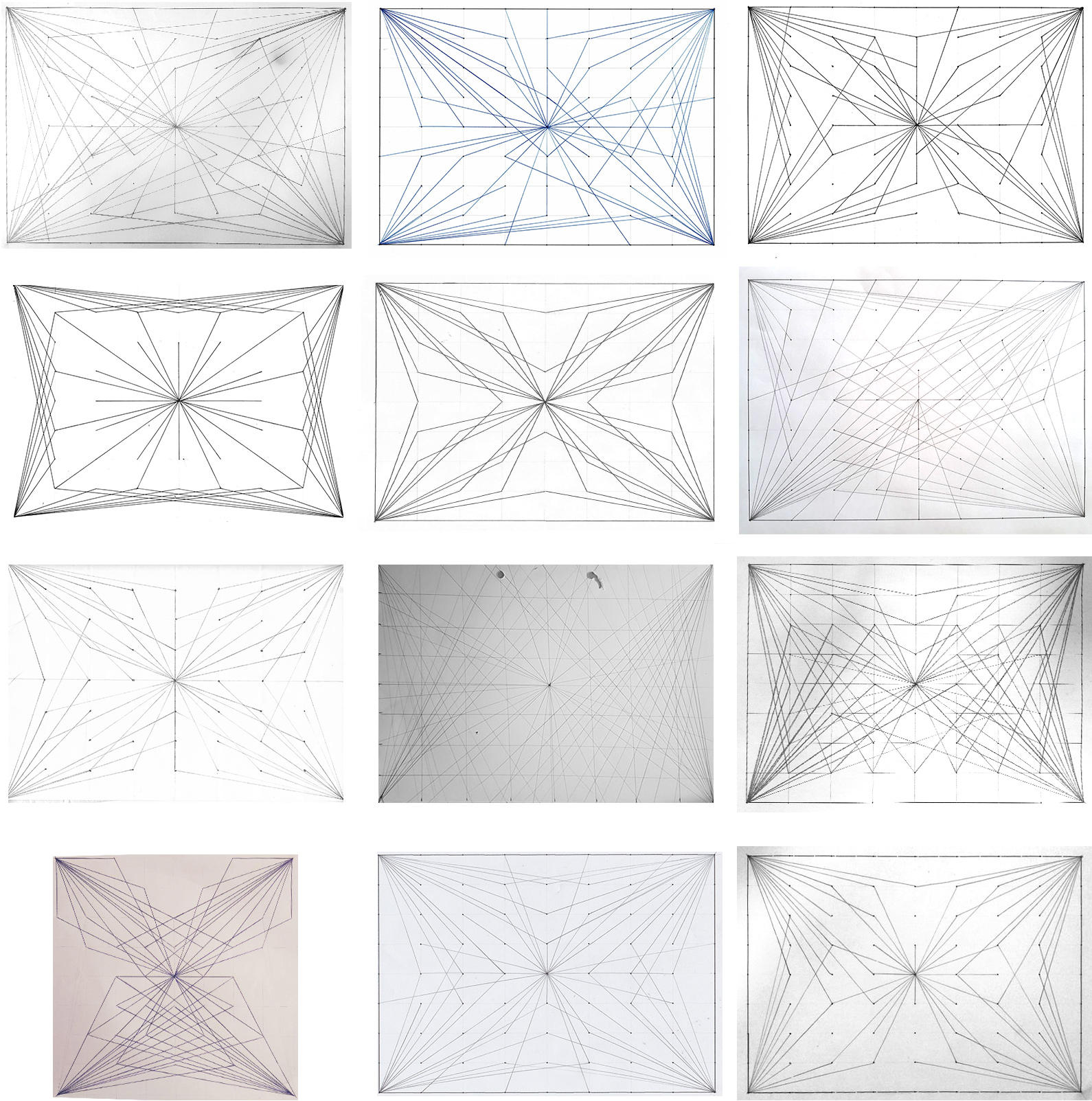
Of course since most households nowadays sport a potent machinery that is created to do just that, the popularity of generative design has strong bounds to the digital age. Nevertheless there are poignant modern examples that build on the original idea.
In 1968, Sol LeWitt began creating his wall drawings, which consist solely of written instructions and diagrams for others to execute.
Art Machines
Early drawing machines were based on physical systems that produced a visual output. While not strictly rule-based their algorithmic quality can be argued as inherent in the physical construction of the apparatus. The Harmonograph for instance became popular in the mid 19th century and uses a set of pendulums set in motion for a direct visual output of an intricate variety.
Jean Tinguely
Jean Tinguely exhibits the drawing machine as a sculpture in motion which produces an artefact. Instead of control he emphasises a playful and erratic approach. At an exhibition he installs a Metamatic-Automat where the visitors could insert coins to have their artwork produced before their eyes and raises the question of authorship.
He illustrates the meta quality not only by its titles but also by referring to ideologic predecessors in art history.
Early (analogue) computer art
Visually similar to harmonograph drawings, Desmond Paul Henry employed military technology from World War II bombers to create his complex drawings.
Early Computer Aided Animation
John and James Whitney also used a modified WWII computer to construct an apparatus that allowed them to animate and transform geometric shapes for cinematic uses.